Table of Contents
Exploring Sound Diffusers Through Computational Design
Click here to explore the Part 1 of this series
Sound is invisible.
But its behavior is not random.
In architecture, product design, and spatial environments, controlling sound is not about decoration. It is about geometry. Flat surfaces reflect sound predictably. Parallel walls create flutter echo. Enclosed volumes amplify certain frequencies and cancel others.
Absorption removes energy.
Diffusion redistributes it.
This blog explores how sound diffusers work, and more importantly, how computational design enables their creation.
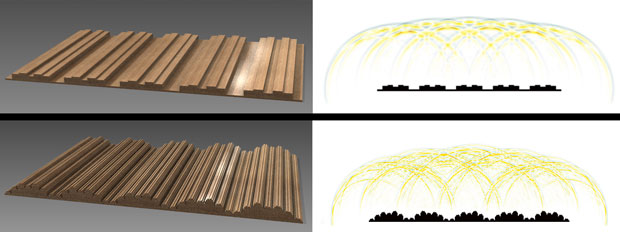
The Physics of Sound Diffusion
Sound travels as a wave. Two physical properties determine how it interacts with geometry:
Frequency
Measured in Hertz. Higher frequency means shorter wavelength.
Wavelength
Wavelength equals speed of sound divided by frequency.
At room temperature, sound travels roughly 343 meters per second. A 1000 Hz tone has a wavelength of approximately 0.34 meters. A 125 Hz tone has a wavelength of about 2.7 meters.
Why does this matter?
Because a diffuser must have geometric dimensions comparable to the wavelength it is intended to scatter.
If the surface variation is too small, low frequencies ignore it.
If the surface depth is too shallow, diffusion only affects high frequencies.
Geometry controls time.
Time controls interference.
Interference controls spatial sound distribution.
Diffusion operates through controlled phase shifts. When sound waves strike surfaces with varying depths, each reflected wave returns at a slightly different time. These small time offsets cause the energy to spread across multiple angles instead of reinforcing in a single direction. Geometry influences timing, timing influences interference, and interference determines how evenly sound energy fills a room.
Why Is Diffusion Needed?
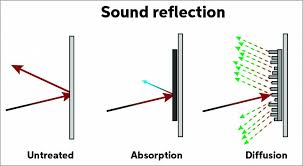
Rectangular rooms with parallel walls often suffer from what is commonly known as slap echo. This occurs when sound waves bounce repeatedly between opposing flat surfaces, creating sharp, repetitive reflections. These reflections disrupt the delicate phase relationships required to form a clear and accurate soundstage.
In critical listening environments such as home theaters, recording studios, mixing control rooms, music venues, auditoriums, and gymnasiums, this disruption can severely compromise sound quality. The result is a space that feels harsh, unfocused, or acoustically overwhelming.
Most people have experienced this effect. Think about attending an event in a noisy gymnasium, sitting in an untreated auditorium, or trying to hold a conversation in a restaurant where sound seems to bounce endlessly around the room. Reflections build upon one another, reducing speech intelligibility and making it difficult to isolate individual sounds.
This is precisely why both absorption and diffusion are essential. Absorption reduces excessive reflections by removing energy, while diffusion redistributes reflected energy evenly throughout the space. Together, they create a balanced acoustic environment that supports clarity without making the room sound unnaturally dull.
Different Listening Environments and Practical Guidelines
Every listening space has different acoustic goals. A home theater aims for immersive cinematic impact. A control room demands precision and accuracy. A casual listening room may prioritize warmth and spatial depth. The appropriate diffusion strategy depends on the intended sound field, the geometry of the room, and the placement of sound sources.
While each project requires careful analysis, the following general guidelines can help inform diffuser placement:
-
Be aware of the location of the primary sound source within the room.
-
Identify and treat areas where slap echo is most prominent, especially between parallel walls.
-
Before installing diffusers, note any dead spots where sound feels weak or uneven.
-
Consider the ceiling as a reflective surface that often requires diffusion.
-
Take the overall shape and proportions of the room into account.
-
The rear wall, behind the listening position, is typically the most critical area for diffusion. After addressing this, the front wall and ceiling should also be evaluated.
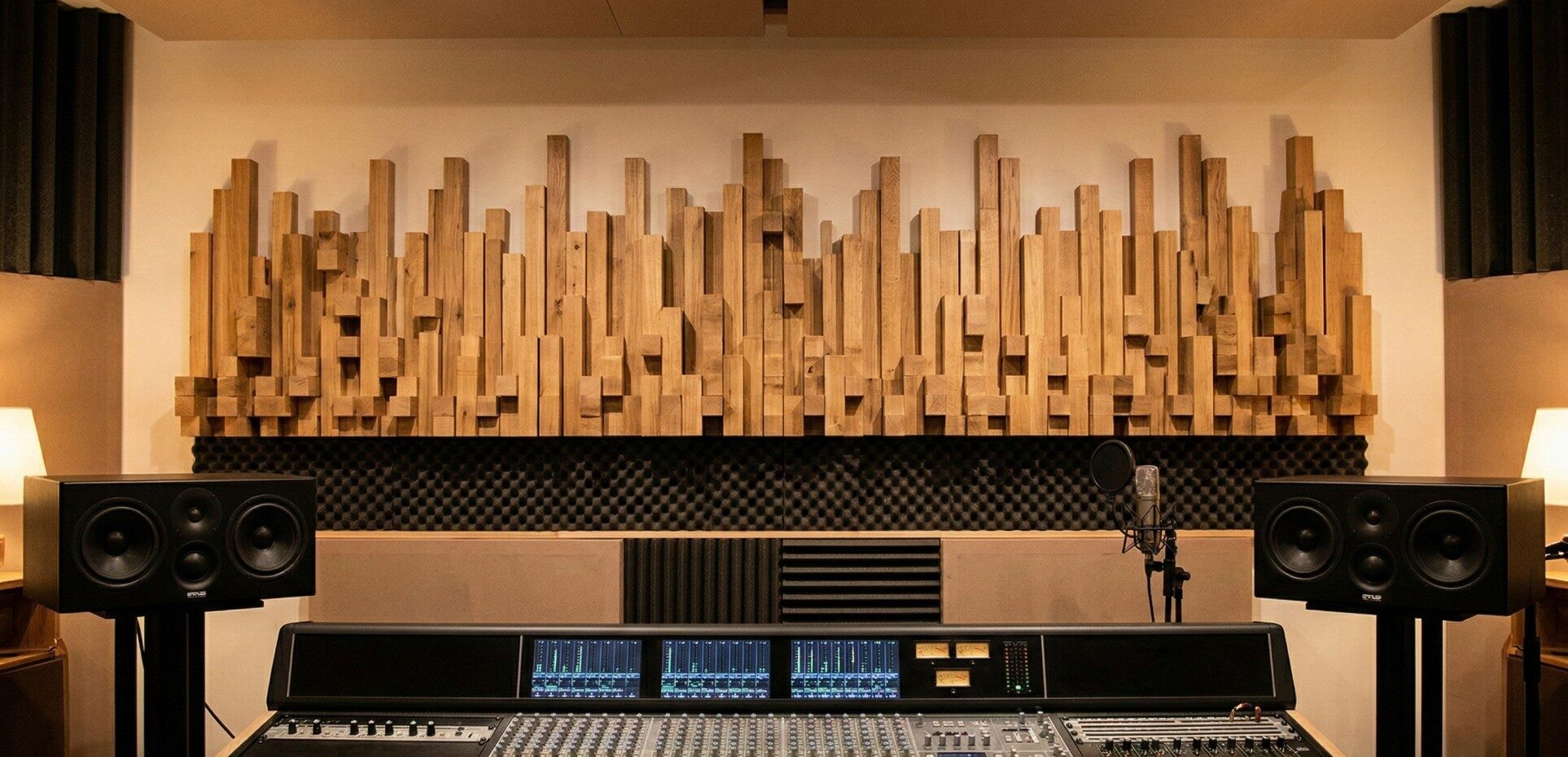
Proper diffusion is not about randomly adding textured panels. It is about understanding how geometry interacts with sound energy and strategically shaping reflections to enhance clarity, depth, and balance.
Types of Sound Diffusers
1. Quadratic Residue Diffusers (QRD)
Quadratic Residue Diffusers are among the most studied and widely implemented diffuser systems. Their geometry is derived from quadratic residue sequences based on modular arithmetic. Each well in the panel has a depth determined by a mathematical formula, producing a structured yet non-repeating pattern.
When sound reflects off these wells, varying depths introduce controlled phase shifts. The reflections return at slightly different times, spreading energy across angles instead of reinforcing a single direction.
What makes QRDs particularly powerful is their rule-based structure. Change the sequence length or maximum depth and the entire surface regenerates while preserving acoustic logic. The form is a direct output of mathematical control.
2. Primitive Root Diffusers (PRD)
Primitive Root Diffusers are conceptually similar to QRDs but use primitive root sequences instead of quadratic residues. The resulting patterns tend to be less visually symmetric and can produce smoother diffusion characteristics in certain frequency ranges.
The distinction may seem subtle, but mathematically driven variation leads to different scattering behavior. By shifting the generative rule, the geometry reorganizes itself while maintaining predictable acoustic performance.
This highlights an important principle: diffusion is not random texture. It is structured variation defined by underlying logic.
3. Maximum Length Sequence (MLS) Diffusers
MLS diffusers rely on pseudo-random binary sequences rather than purely quadratic formulas. Instead of strict number-theory progression, they introduce controlled randomness into height distribution.
This approach produces scattering that appears irregular but is mathematically deterministic. The pseudo-random nature reduces predictable symmetry while maintaining statistical uniformity.
Here, diffusion emerges from structured noise rather than orderly sequences, demonstrating that randomness in acoustics can still be rule-governed.
4. Binary Amplitude Diffusers (BAD Panels)
Binary Amplitude Diffusers combine diffusion and absorption. Instead of deep wells, these panels use binary patterns of reflective and absorptive regions, often through perforations or material changes.
The alternating surface states disrupt wave reflections while simultaneously dissipating some energy. This hybrid approach allows more controlled tuning of mid and high frequencies.
Rather than relying on depth alone, performance here emerges from pattern logic and material differentiation, showing that diffusion can be embedded in surface topology as much as in geometry.
5. Poly-Cylindrical or Curved Diffusers
Not all diffusers rely on discrete wells or grids. Poly-cylindrical diffusers use smooth convex curves, often cylindrical segments, to scatter sound.
When sound strikes a curved surface, it reflects across a continuous range of angles rather than a single predictable direction. The radius of curvature determines which frequency ranges are most effectively scattered.
This type of diffusion is driven purely by geometric reflection principles. Instead of numeric sequences, curvature itself becomes the controlling variable.
6. Fractal Diffusers
Fractal diffusers operate at multiple scales. Smaller diffusive elements are nested within larger ones, creating hierarchical geometry.
Because different frequencies respond to different dimensional scales, multi-scale surfaces can scatter a broader bandwidth of sound. High frequencies interact with smaller features, while lower frequencies respond to larger structures.
This recursive logic mirrors natural systems. Performance is embedded in repetition across scales, not just variation within a single grid.
A Unifying Perspective
Across all eight types, one principle remains constant: diffusion is controlled geometric variation at relevant scales.
Some systems use number theory.
Some use pseudo-random logic.
Some rely on curvature.
Some operate hierarchically across scales.
In every case, performance is not decorative. It is encoded in structure.
When surfaces are defined by rules instead of arbitrary shapes, adjusting one variable can reshape the entire acoustic behavior. Diffusers become systems rather than objects.
And that is where acoustic design begins to align naturally with computational thinking, where geometry is not manually sculpted but generated through relationships.
Sound, ultimately, is shaped by structure.