Table of Contents
AI is moving quickly through software and knowledge work. But walk into a factory, fabrication workshop, machine shop, or construction site, and the picture is different.
Many physical industries still depend heavily on people who understand how things are designed, engineered, produced, and assembled.
Anthropic’s Economic Index has found that AI use remains highly uneven across the economy, with software development and other knowledge-work activities accounting for a large share of usage, while occupations involving substantial physical work are far less represented. In its initial analysis, farming, fishing, and forestry accounted for just 0.1% of Claude-related queries.
The opportunity, then, isn’t simply to bring AI into these industries. It is to figure out how computation, design, and production can work together.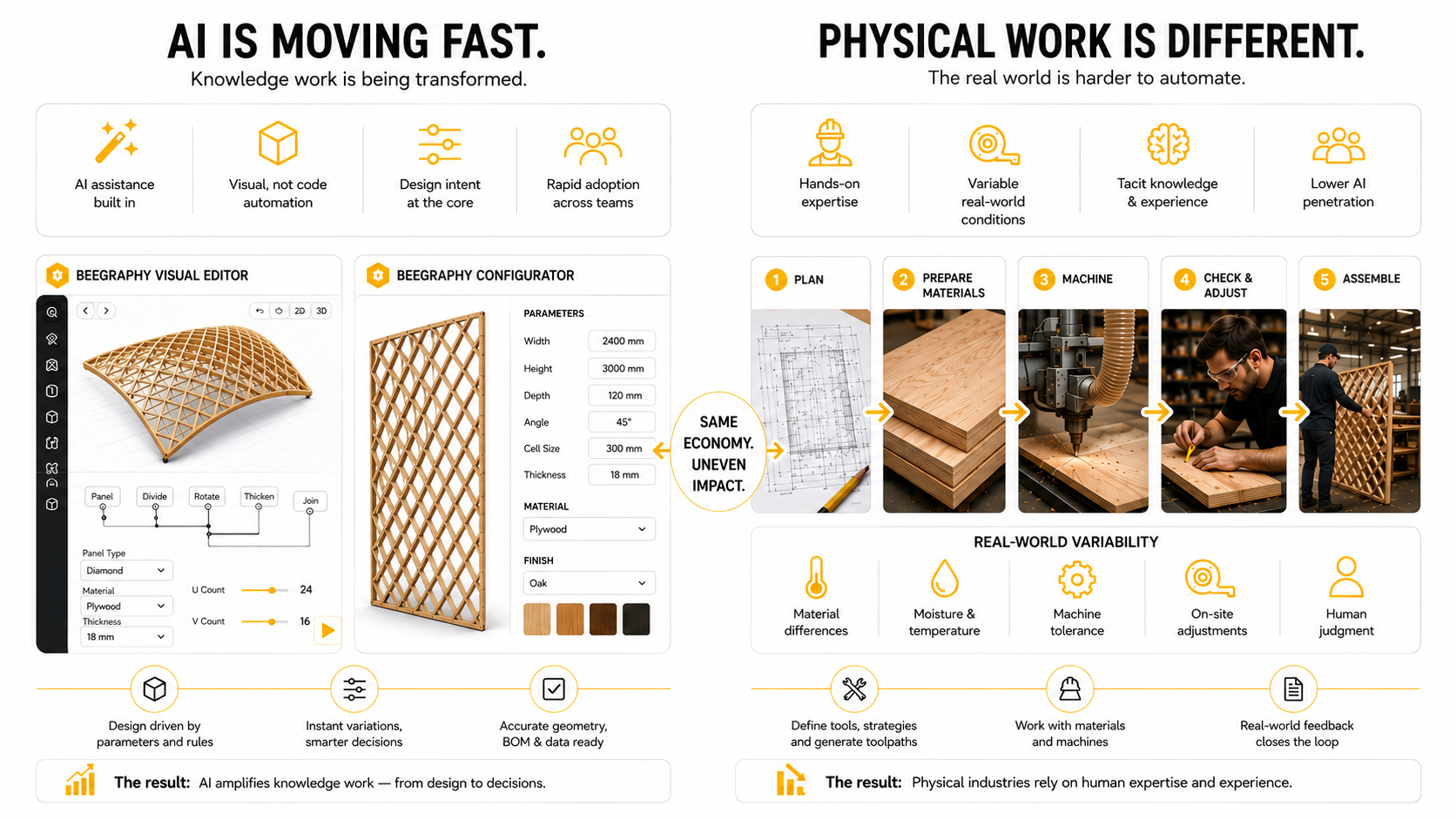
The next skills gap isn’t only about AI
Today’s designers and engineers already have powerful digital tools:
- CAD and parametric modeling
- Simulation and analysis
- Automation and scripting
- AI and generative systems
- CNC and digital fabrication
- Robotics and advanced manufacturing
The challenge is knowing how to connect them to solve real problems.
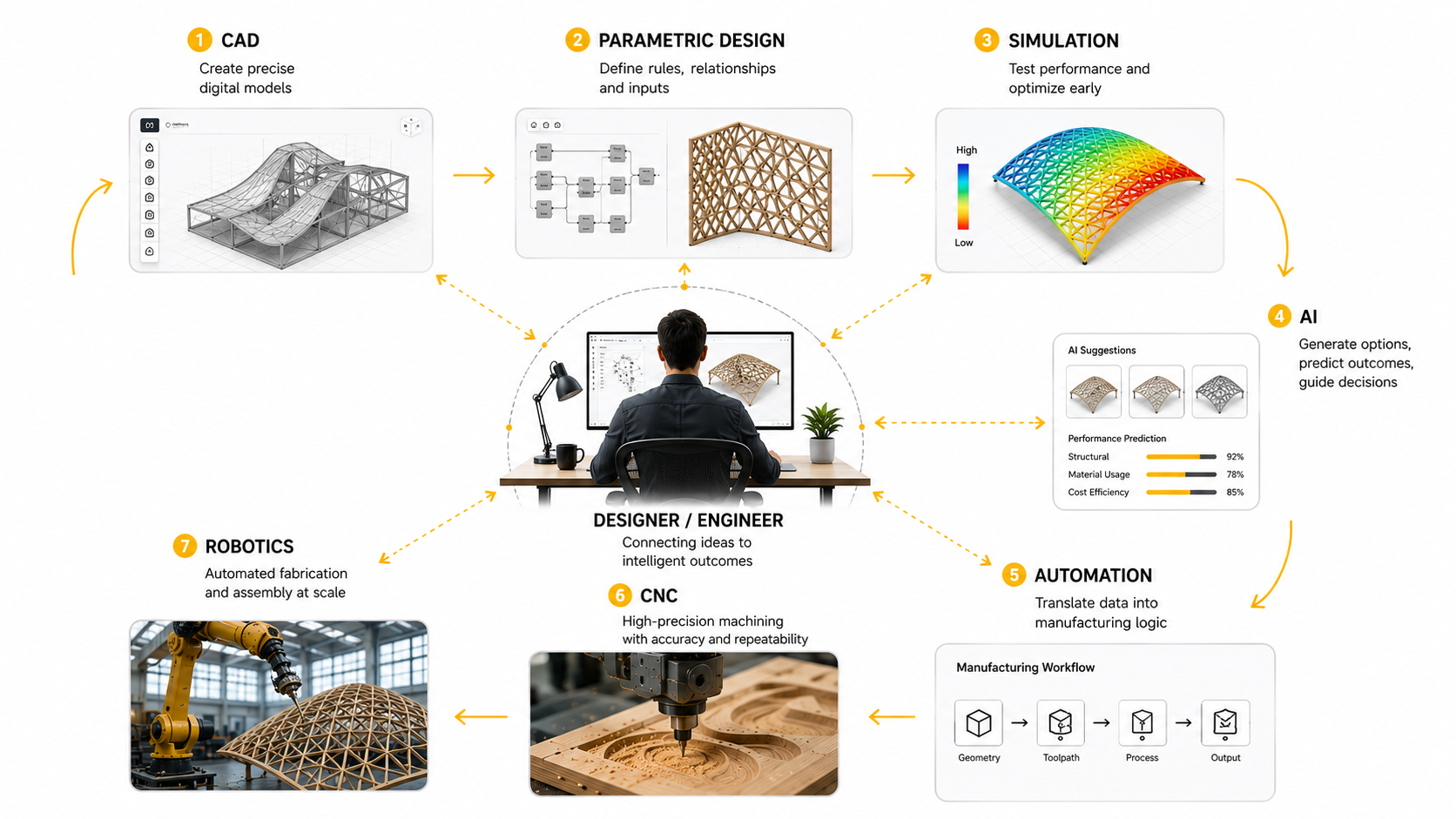
The World Economic Forum’s Future of Jobs Report 2025 estimates that almost 40% of workers’ core skills will change by 2030, while 63% of employers identify skills gaps as a major barrier to transformation. This creates demand for people who can work across disciplines — people who understand design, computation, and the realities of making things. That is where computational design comes in.
What exactly does a computational designer do?
There is no single definition. A computational designer might work with software, write code, build parametric models, automate workflows, develop generative systems, or work with simulation and optimization. But the software isn’t what defines the role. A computational designer starts by asking: Can this design problem be described as a system?
Instead of designing every outcome individually, a computational designer defines the parameters and constraints that drive the design, allowing everything from product variations to facade layouts to adapt automatically.
The work therefore often involves:
- Identifying the variables that matter.
- Defining relationships between them.
- Encoding constraints and rules.
- Generating and evaluating possible outcomes.
- Automating repetitive decisions.
The result is not necessarily a complicated piece of software. It could be a configurable chair, a responsive facade, a fabrication layout, a structural system, or a production workflow.
What changes when you design this way?
Wherein, a conventional design process asks: “What should this object look like?” A computational approach also questions: “What should determine what it looks like?”
That shift allows one system to produce many outcomes. For example, changing a few inputs could automatically update:
- Product dimensions
- Component positions
- Material quantities
- Fabrication layouts
- Production geometry
- Documentation
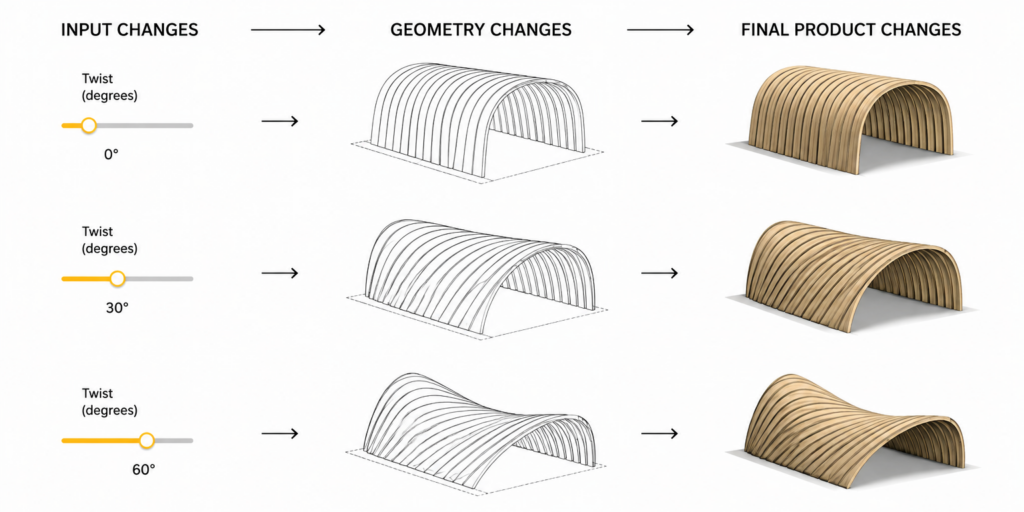
The designer is no longer redrawing every version. They are deciding which relationships should control the result. This is particularly useful when a design has many variables, many possible configurations, or frequent changes.
What does the job actually involve?
Computational design is rarely just sitting in front of a node editor. Depending on the project, a computational designer may:
- Build parametric or generative models.
- Develop design automation.
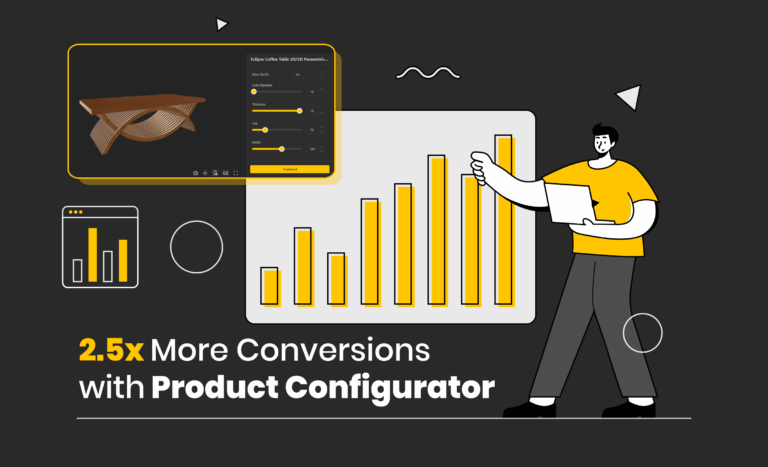
- Create product configurators.
- Analyze and optimize geometry.
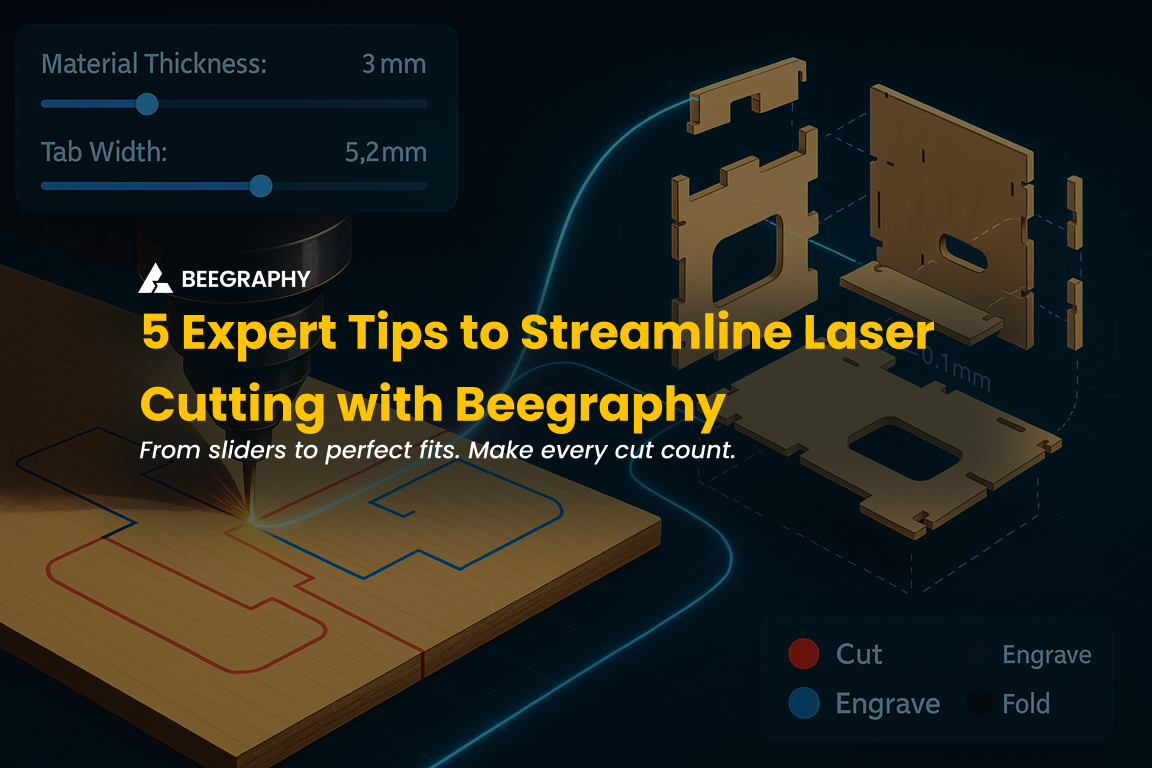
- Prepare models for fabrication.
- Work with engineers, architects, manufacturers, or product teams.
- Translate physical constraints into computational rules.
- Build tools that other designers can use.
The common thread is problem-solving. A good computational designer needs to know what is worth automating and what shouldn’t be. That requires more than software knowledge. It requires understanding the design problem itself.
The skills behind the role
There is no fixed skill set, but computational designers commonly combine several areas:
Design & geometry
Understanding form, space, dimensions, and design intent.
Computational thinking
Breaking complex problems into inputs, relationships, conditions, and outputs.
Programming & visual programming
Using tools such as node-based systems, scripting, or APIs to build workflows.
Analysis & optimization
Testing alternatives against defined criteria rather than relying only on manual iteration.
Domain knowledge
Understanding the realities of architecture, engineering, manufacturing, materials, construction, or product development.
The most important skill may be the ability to move between these areas and understand how one affects another.
From digital design to physical production
This is where computational design gets particularly interesting. A digital model can generate thousands of possibilities. But the physical world still imposes limits.
A design might need to account for:
- Material dimensions
- Machine capabilities
- Manufacturing tolerances
- Assembly requirements
- Structural constraints
- Production costs
- Available tooling
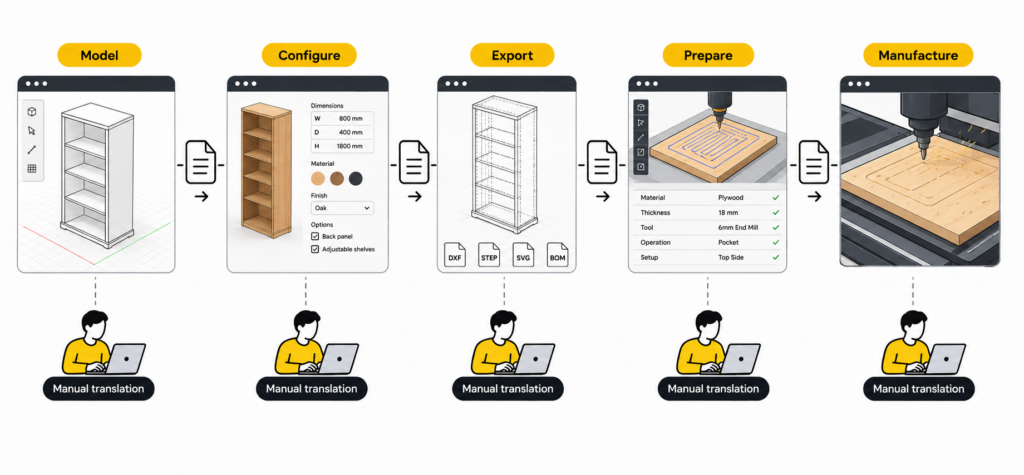
A useful system therefore cannot stop at generating geometry. It has to produce something that can actually be made. This is also where many current workflows become fragmented. Each stage can happen in a different application, often requiring files to be exported, reformatted, or rebuilt. When something changes earlier in the process, downstream work may need to be repeated. The problem isn’t necessarily the individual tools.
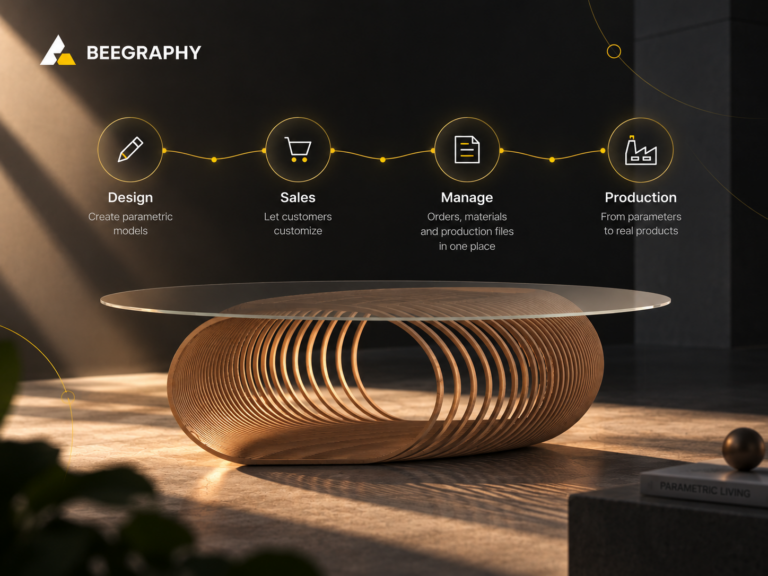
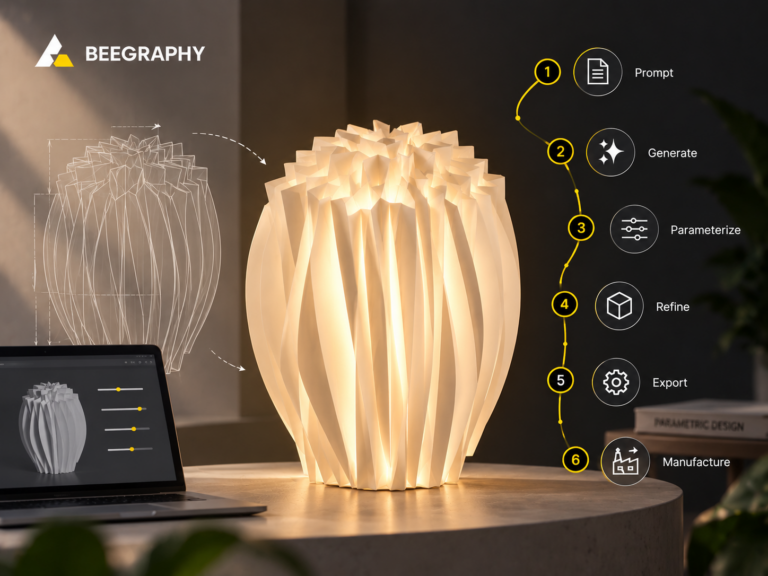
It’s the handoffs between them. A designer might: Model → Configure → Export → Prepare → Manufacture
So where does BeeGraphy fit?
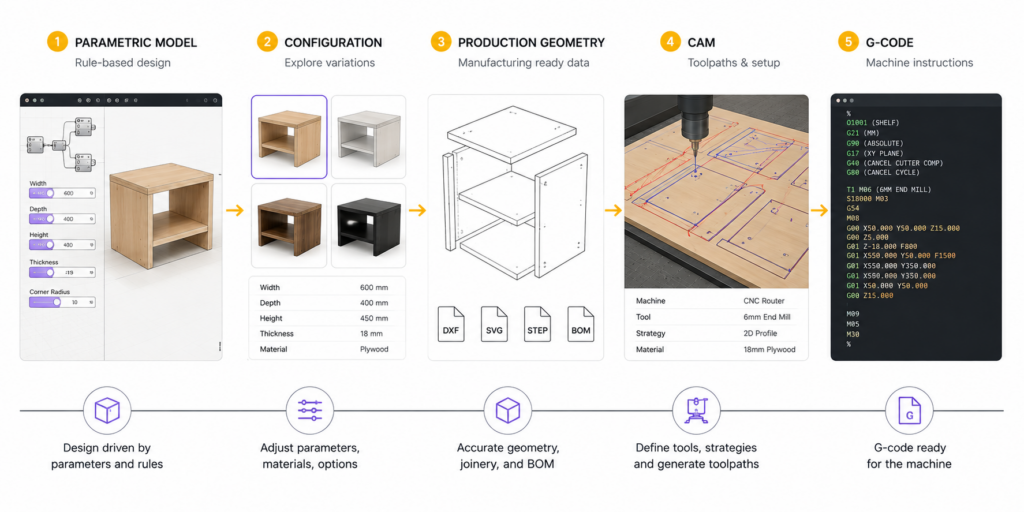
BeeGraphy approaches computational design from this workflow perspective. The idea is to keep the computational logic connected as a design moves toward production. A workflow can begin with a parametric product model, expose its parameters for configuration, generate the corresponding production geometry, and continue into manufacturing workflows such as CAM and G-code. Instead of rebuilding the next stage every time something changes, the underlying model can continue to drive the workflow. For a computational designer, this means the model can become more than a design file. It can become the system connecting design decisions to production.
Parametric Model → Configuration → Production Geometry → CAM → G-code
How do you become a computational designer?
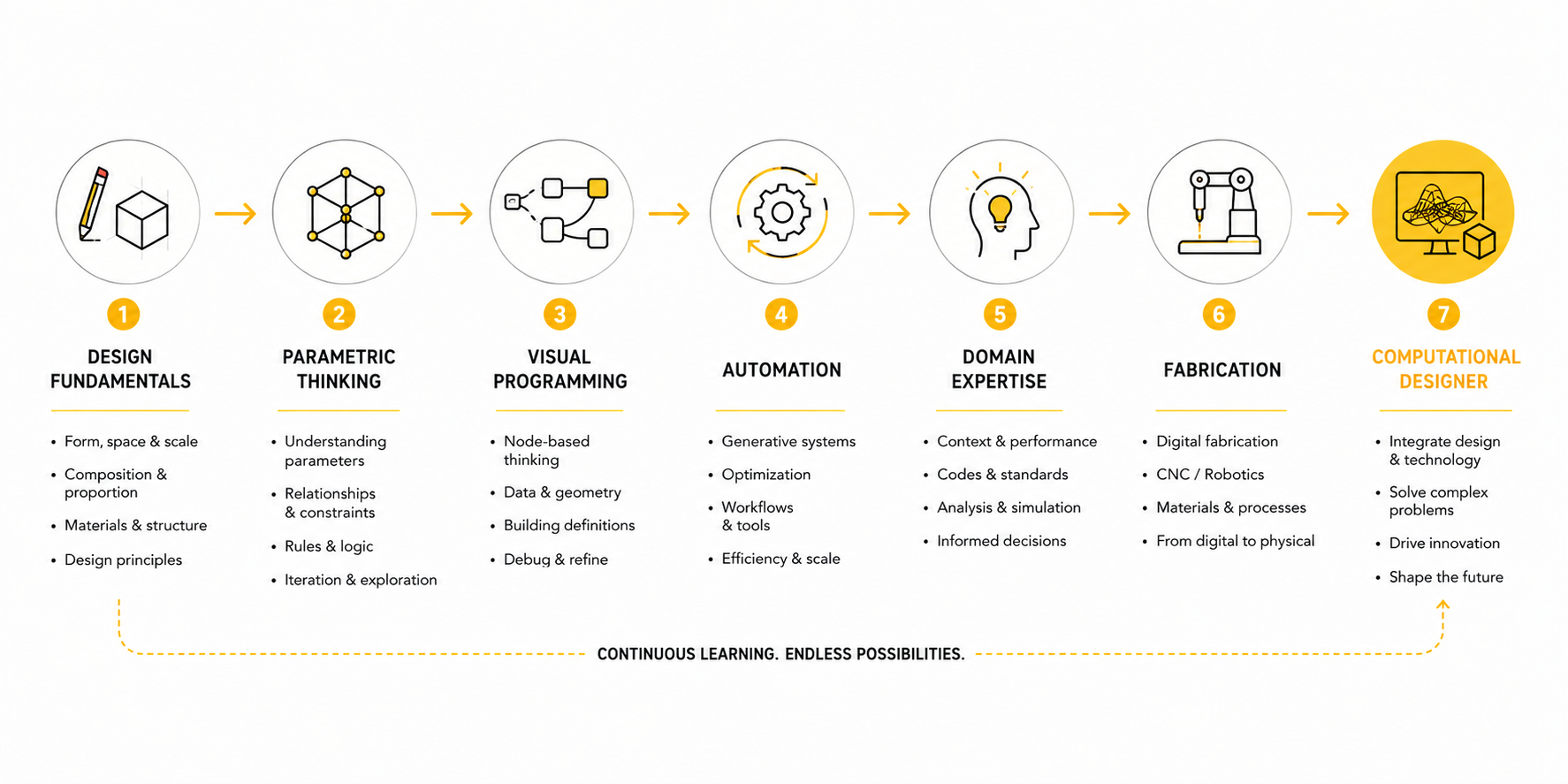
There isn’t one required degree, job title, or software package.
A practical path is to build the skills progressively:
- Learn the fundamentals: geometry, design, and problem-solving.
- Learn parametric thinking: understand variables, relationships, and constraints.
- Build computational workflows: start with visual programming, then add scripting where useful.
- Work on real problems: automate something repetitive or build something that responds to changing inputs.
- Add domain knowledge: understand the industry you want to work in.
- Learn production: understand how designs are actually fabricated, manufactured, or constructed.
The goal isn’t to learn every tool. It is to become comfortable asking: “What can be described, automated, tested, or improved computationally?”
The bigger opportunity
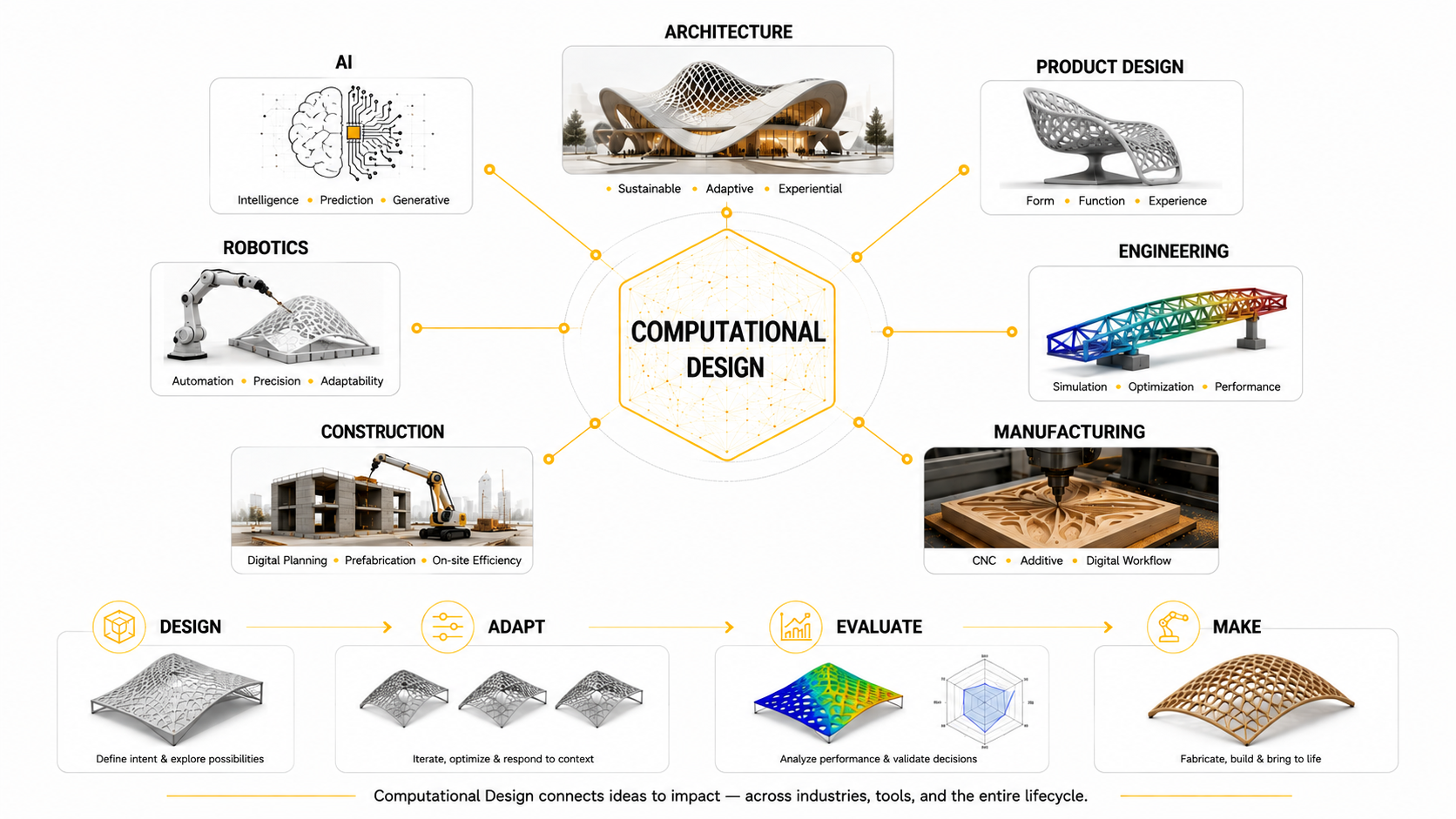
Computational design doesn’t have to replace an existing profession.
It can extend one.
- An architect can use it to explore more complex design possibilities.
- A product designer can build configurable products instead of manually creating every variant.
- An engineer can automate analysis and geometry generation.
- A manufacturer can connect design decisions more directly to production.
- A maker can develop systems capable of producing an entire family of products.
As AI, automation, digital design, and manufacturing continue to converge, the valuable skill won’t simply be knowing how to use more software. It will be knowing where computation can make the work better. And that may be the real role of the computational designer and not just designing what gets made, but designing how it can be designed, adapted, and made.