Table of Contents
If you sell furniture online, you have probably opened a furniture configurator hoping to design a sofa and found a colour picker instead. You can choose the fabric, the leg finish, maybe the number of seats. You cannot make it 12 cm shorter to fit the alcove, or soften the curve of the arm.
We wanted to know how true that feeling is, so we went through 10 public furniture configurators, from Herman Miller and IKEA to Tylko and India’s Wakefit. For each one we noted what a buyer can actually change, using the brand’s own product pages.
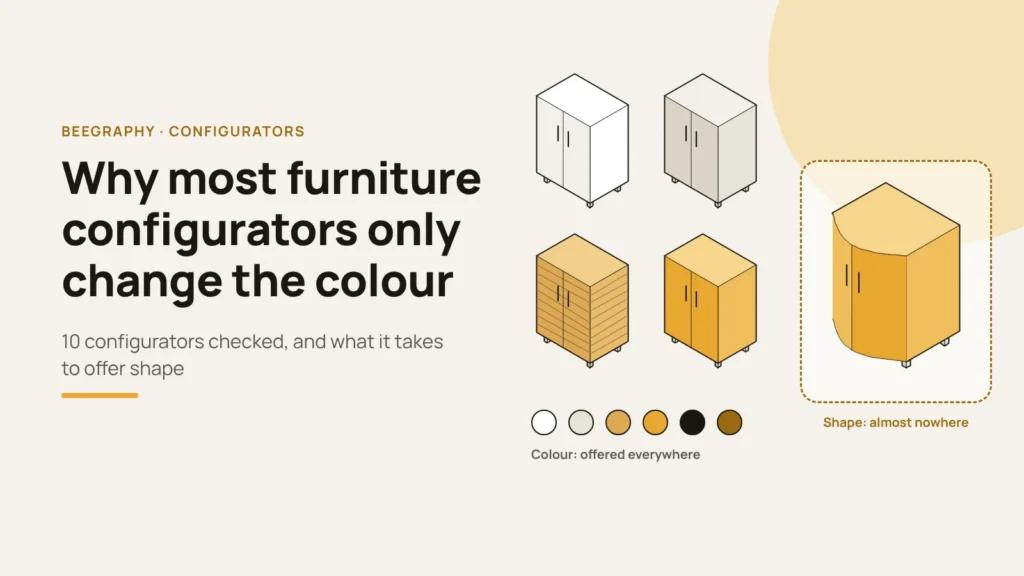
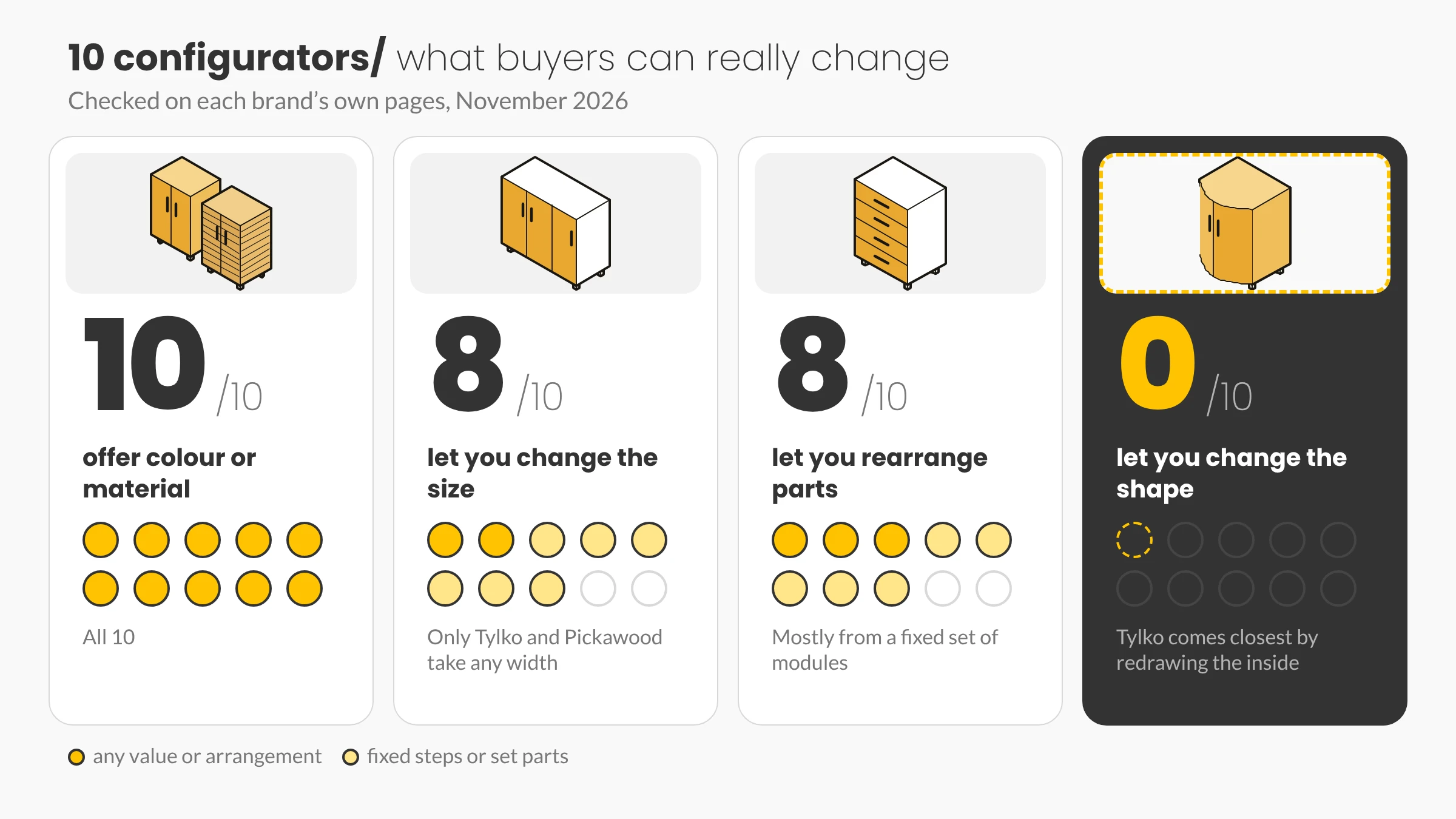
The short answer: every one of them lets you change colour or material. Eight offer some choice of size, but only two take a width to the centimetre. None lets the buyer change the shape of the piece.
That is not because the brands lack imagination. It is because each kind of choice costs the maker something different, and shape costs the most. This post lays out the five levels of choice, shows where each configurator sits, explains why most stop at colour, and looks at what changes when the product is built as a set of rules instead of a set of drawings.
The five levels of choice in a furniture configurator
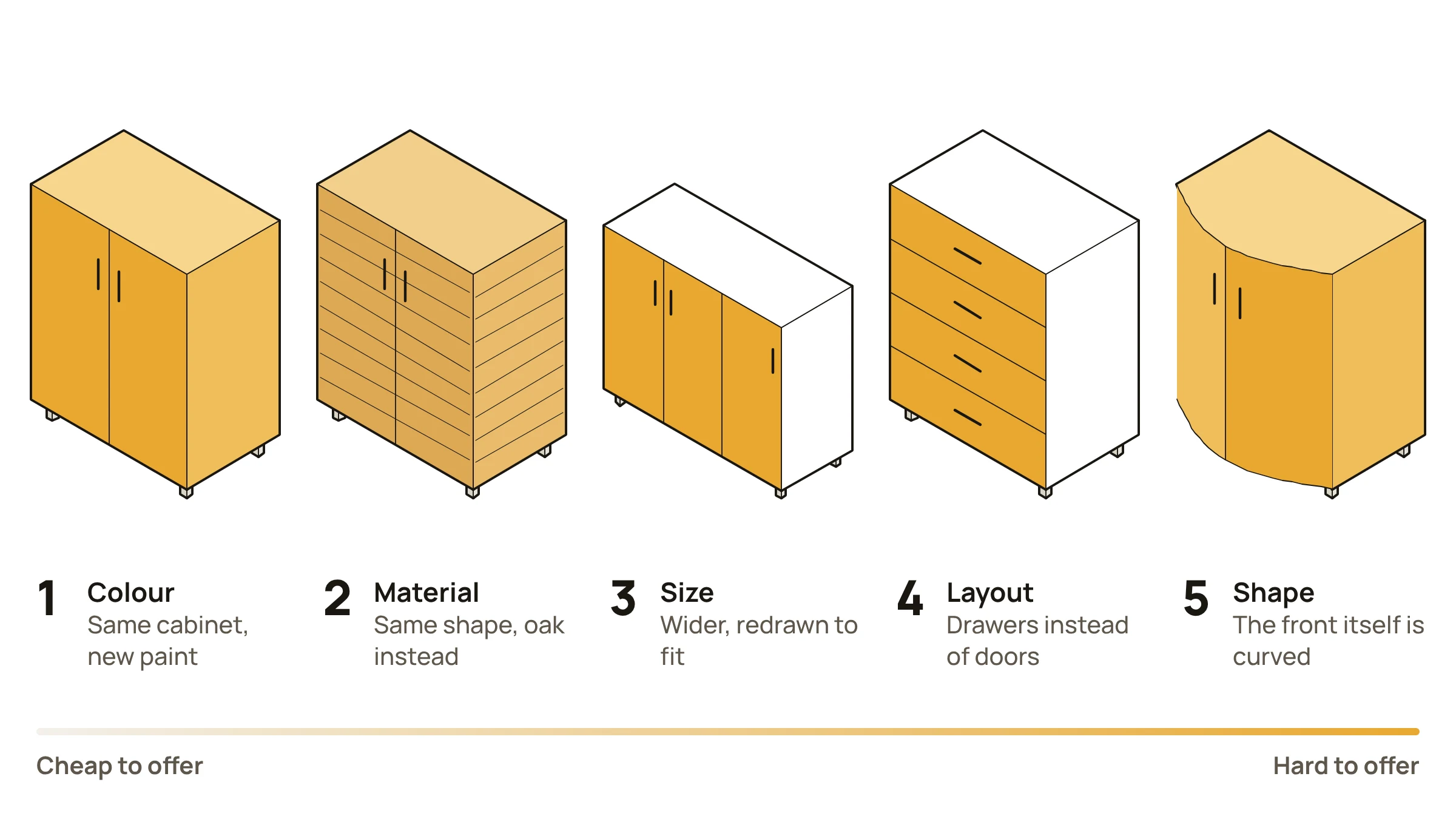
Not all customisation is the same. A buyer who picks a walnut veneer has changed something very different from a buyer who sets a cabinet to 1,370 mm wide. To compare configurators fairly, we sorted every option into five levels, from the cheapest for a maker to offer to the hardest.
- Colour. The same part in a different paint, stain or fabric colour. Nothing about the geometry changes.
- Material. A different veneer, board, metal or fabric type. The shape stays the same, but the maker may need a different supplier, edge banding or price.
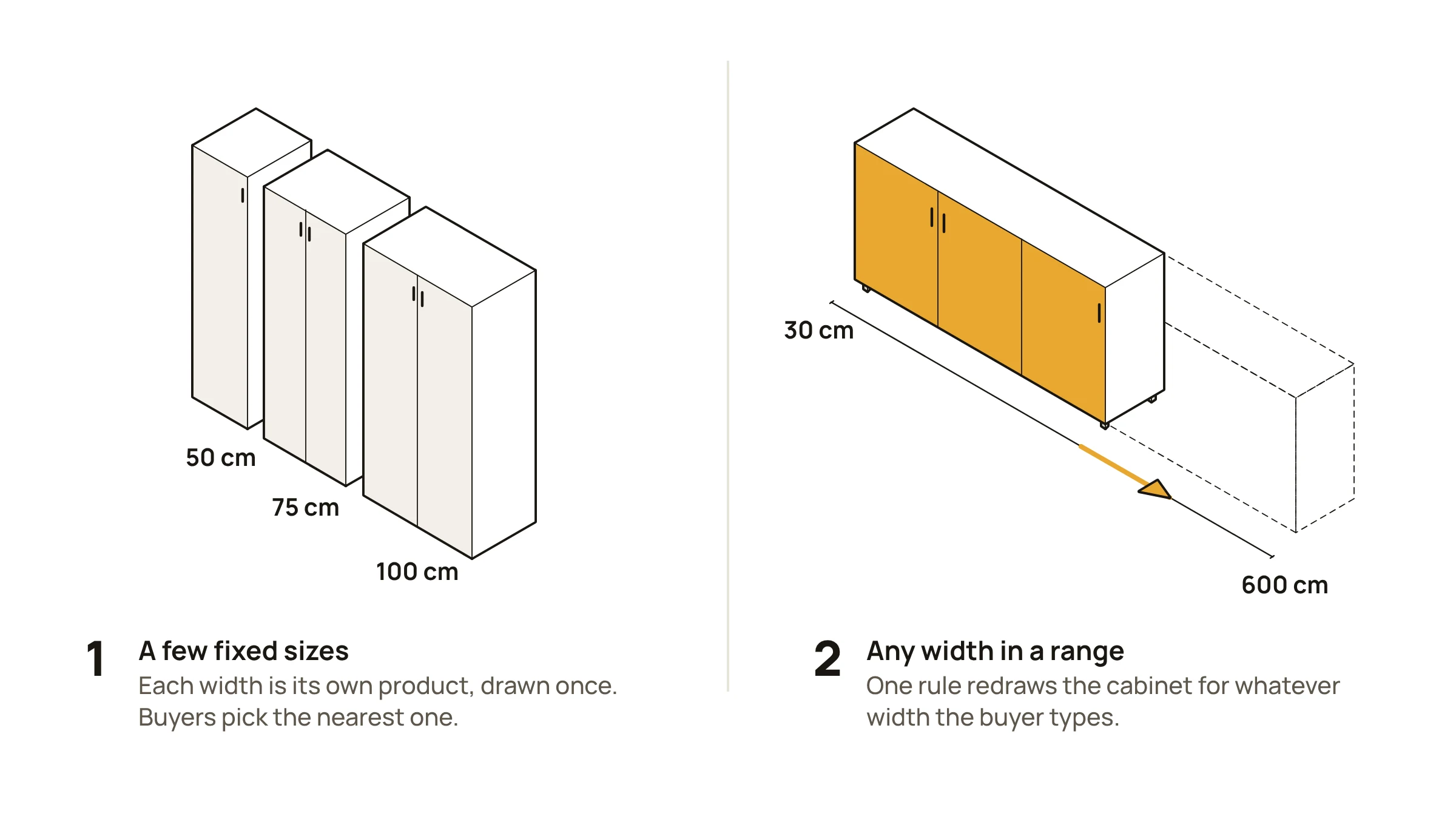
- Size. The piece gets wider, taller or deeper. Sometimes this means a few fixed sizes, such as 50, 75 or 100 cm. Sometimes it means any value in a range.
- Layout. The parts are rearranged: more shelves, a drawer instead of a door, a corner piece added to a sofa. The parts stay the same; their number and order change.
- Shape. The form itself changes: a curve gets deeper, a profile changes, a top goes from rectangle to rounded. The parts are redrawn, not just repeated.
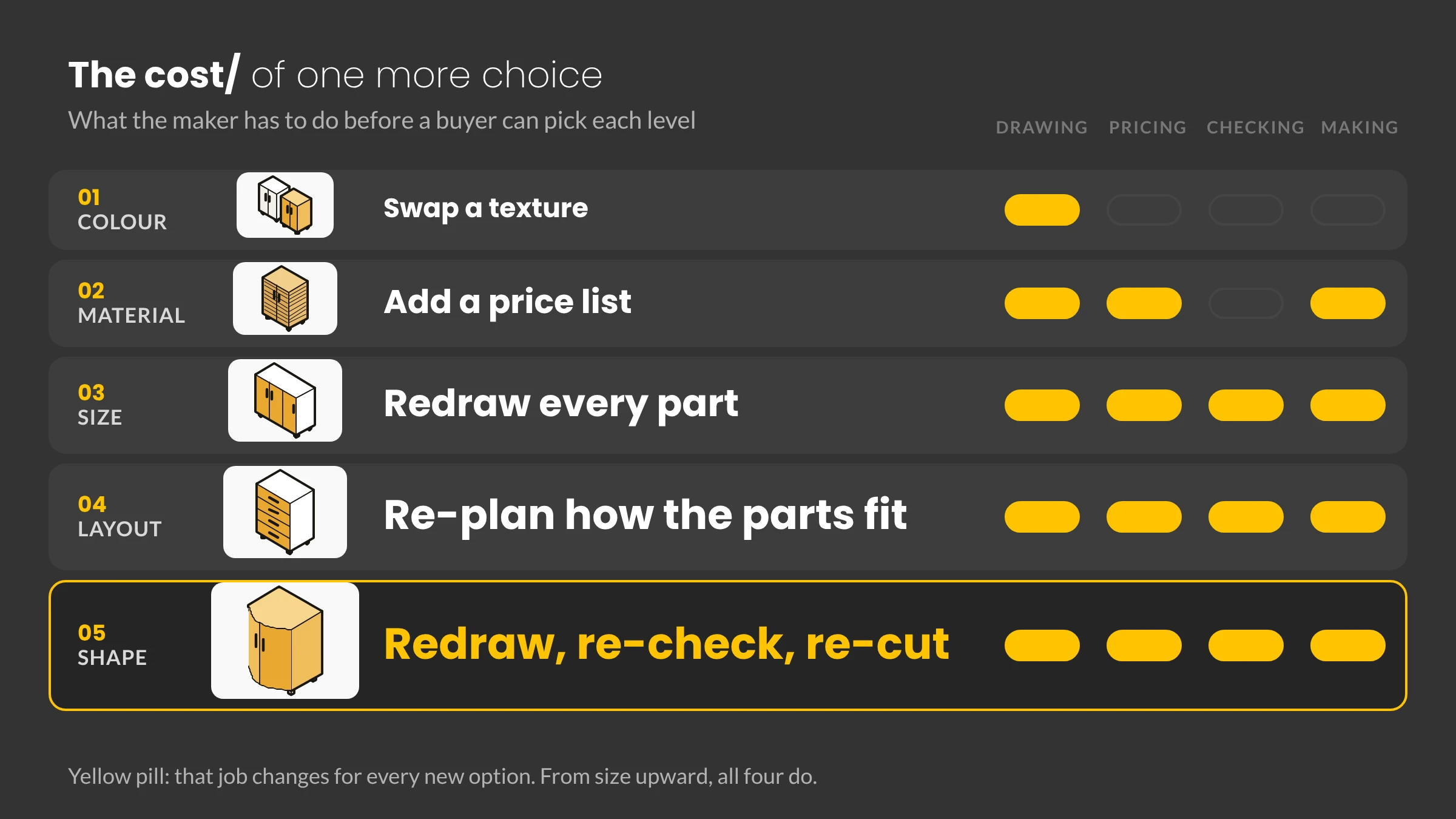
Each level up asks more of the maker. Colour needs a new texture on screen. A fixed size needs one more drawing. A free size needs a rule that redraws the piece for any value. A new shape needs a rule that also checks the result can still be cut, joined and carried home.
What 10 furniture configurators let you change
Here is what each furniture configurator offered on its own product page when we checked it in November 2026. Where a brand’s page gave little detail, we used one independent review and say so.
| Configurator | Colour / material | Size | Layout | Shape | What the buyer picks |
|---|---|---|---|---|---|
| Herman Miller Eames Lounge Chair | Yes | Two sizes | No | No | Standard or Tall, 7 veneers, 10 upholstery families |
| Vitra Eames Plastic Chairs | Yes | No | Parts swap | No | 23 shell colours, 36 upholstery options, a choice of bases |
| Burrow Nomad sofa | Yes | No | Modules | No | 5 fabrics, 6 leg finishes, 3 arm heights |
| Wakefit Napper sofa | Yes | Fixed steps | Seat count | No | 356 ready-made variants of size, storage, seats and fabric |
| IKEA PAX wardrobe | Yes | Fixed steps | Modules | No | Frames 50, 75 or 100 cm wide, 201 or 236 cm high, 35 or 58 cm deep |
| USM Haller | Yes | Fixed steps | Grid | No | Standard tube and panel sizes, 14 colours |
| Interior Define (via Apartment Therapy) | Yes | Set lengths | No | No | Length, leg style, cushion style and fill, up to 123 fabrics |
| Arhaus custom upholstery | Yes | Length, depth | Some | No | Length and depth, arm style, fabric, cushion, legs |
| Pickawood | Yes | Free width | Doors, drawers | No | Width 30 to 600 cm, materials, doors and drawers, feet |
| Tylko | Yes | Free width | Density | Closest | Width 30 to 450 cm in 1 cm steps, height in 10 cm steps, 4 depths, density |
The 10 furniture configurators fall into three groups.
Group 1: finish pickers
The two Eames chairs are icons, and their configurators treat them that way. You can dress the Eames Lounge Chair in seven veneers and a long list of leathers and fabrics, and pick Standard or Tall. The Vitra plastic chairs offer 23 shell colours, 36 upholstery options and several bases. The design itself is fixed, which is the point: you are buying a known object in your colours.
Group 2: kits of parts
Burrow, Wakefit, IKEA PAX and USM Haller sell systems. You choose from a fixed set of modules and arrange them. PAX frames come in three widths, two heights and two depths; everything else is what you put inside. Wakefit’s Napper sofa shows the pattern most clearly: one picker with 356 options, every one a product that already exists, and an FAQ that answers “Is the sofa customizable?” with “No.” These furniture configurators feel flexible because the number of combinations is large, but every combination was decided in advance.
Group 3: made to measure
Interior Define, Arhaus, Pickawood and Tylko let the buyer set real dimensions. Interior Define offers a choice of lengths on its sofas, and Arhaus lets buyers change length and depth. Pickawood takes any cabinet width from 30 to 600 cm. Tylko takes any shelf width from 30 to 450 cm in 1 cm steps, and its “density” setting changes how many compartments the shelf has and their proportions. That is the closest any of the 10 comes to changing shape: the outline stays a rectangle, but the inside is redrawn by a rule.
Tylko has called its approach parametric since it launched at the London Design Festival in 2015, and it shows how far a rule can take a product. Even so, the buyer moves sizes and proportions, not the form.
Why most furniture configurators stop at colour
Looking at the table, it is tempting to think brands are being lazy. They are not. Each level of choice changes four jobs behind a furniture configurator’s screen: drawing, pricing, checking and making.
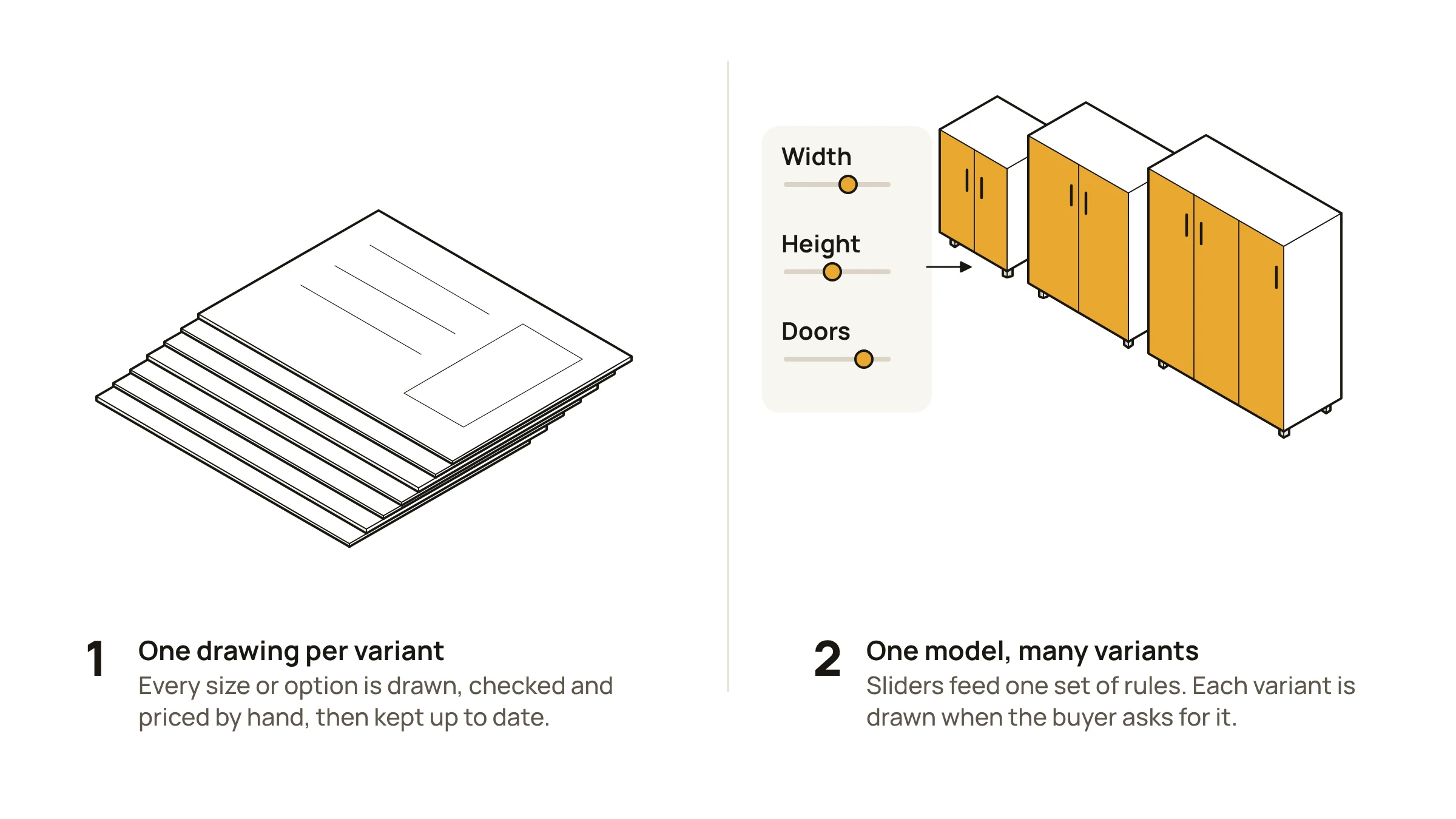
Drawing. A colour option needs one new texture and the same 3D model. A fixed size needs a new drawing, or a new model, for each size. Ten widths of the same cabinet is ten sets of drawings to keep up to date. A free width needs something different: a model that can redraw itself for any width.
Pricing. A fabric swap has a price list. A cabinet that can be any width from 30 to 600 cm uses a different amount of board every time, needs a different number of hinges and takes a different time to cut. The price has to be calculated, not looked up.
Checking. A shelf can be any width, but not every width is safe. Past a certain span the shelf sags, and past the size of a standard board it needs a joint. Someone has to decide those limits and the configurator has to enforce them, or the buyer will order something that cannot be made. We wrote about these rules in why your parametric model needs to understand manufacturing.
Making. The workshop needs cutting lists, drilling positions and machine files for exactly what was ordered. For a fixed product those are made once. For a free size or a new shape they must be made for every order.
There is also the buyer to think about. Research on online customisation points both ways. In a series of studies by Nikolaus Franke, Martin Schreier and Ulrike Kaiser, people were willing to pay more for products they had designed themselves: €6.85 against €4.75 for a T-shirt, and €74.42 against €45.89 for a pair of skis (Management Science, 2010). In the same paper, watches with more design freedom drew higher prices than watches with less.
But more freedom can also confuse. A study of 180 people configuring a laptop online looked at how confusion leads buyers to fall back on the standard model or give up on the purchase (Matzler, Waiguny and Füller, 2007). Work by Benedict Dellaert and Stefan Stremersch found that how a configurator is set up matters as much as how many options it has: a sensible starting design and a single total price made the process feel simpler (ERIM, 2004).
So the brands in the table are making a reasonable trade. Colour and material are cheap to offer and easy to choose. Size and shape are expensive to offer and, if handled badly, hard to choose. Most stop where the cost of offering more outruns what they can check by hand.
The exception: when the buyer sets the curve
Shape is rare, but it is not impossible. Outside our 10, the online shelf maker form.bar sells curved bookshelves whose form the buyer sets. Its page invites you to “pull the deformation points of the shelf and become a designer yourself.” You choose one of three materials, including birch plywood and MDF, and the shelf is built by regional carpenters.
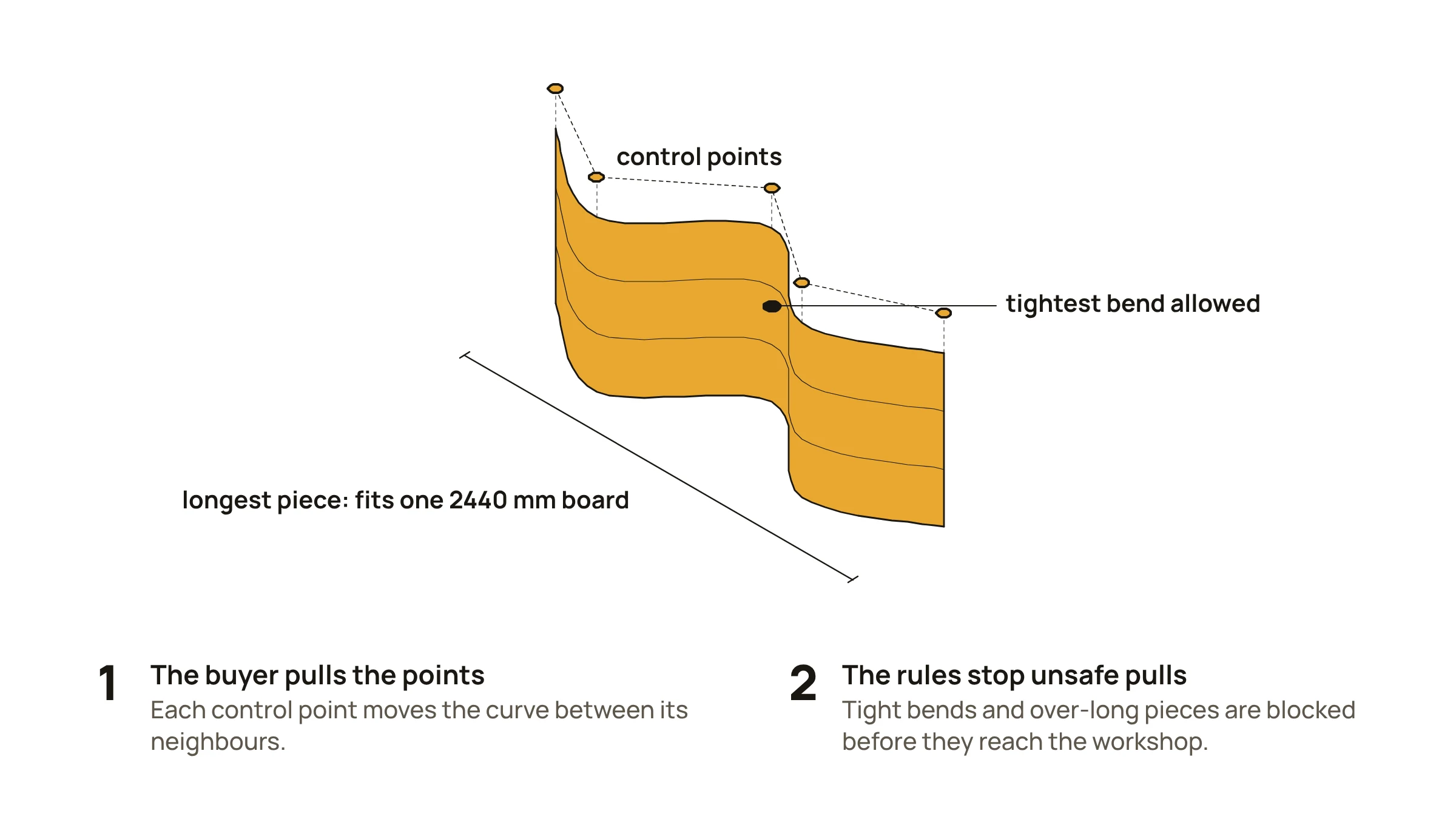
What makes this possible is not the 3D viewer. It is the limits hidden behind it. Any model that offers a curved shelf safely has to know at least:
- how tight a curve the material and the cutting tool can follow,
- how long a piece can be before it no longer fits on a standard board,
- how far apart the uprights must be so the shelves do not sag, and
- where the joints go when one piece is not enough.
The buyer never sees these limits. They simply find that some pulls are allowed and some stop. That is the real work of a shape configurator: not giving the buyer freedom, but giving them freedom inside rules the workshop trusts.
What a rule-based furniture configurator changes
The four jobs above (drawing, pricing, checking and making) are what keep most furniture configurators at colour. A parametric model, one built from rules instead of fixed drawings, changes all four at once.
- Drawing: there is one model, not a library. Width, height or a curve’s depth are inputs, and the model redraws every part from them.
- Checking: limits live inside the model. A slider simply cannot go past the widest safe span or the tightest cuttable curve, so the buyer can only make what the workshop can build.
- Pricing: because the model knows every part it just drew, it can count the board, edging and hardware, and price the order from that.
- Making: the same model that draws the preview can write the cut files, so what the buyer saw is what the machine cuts.
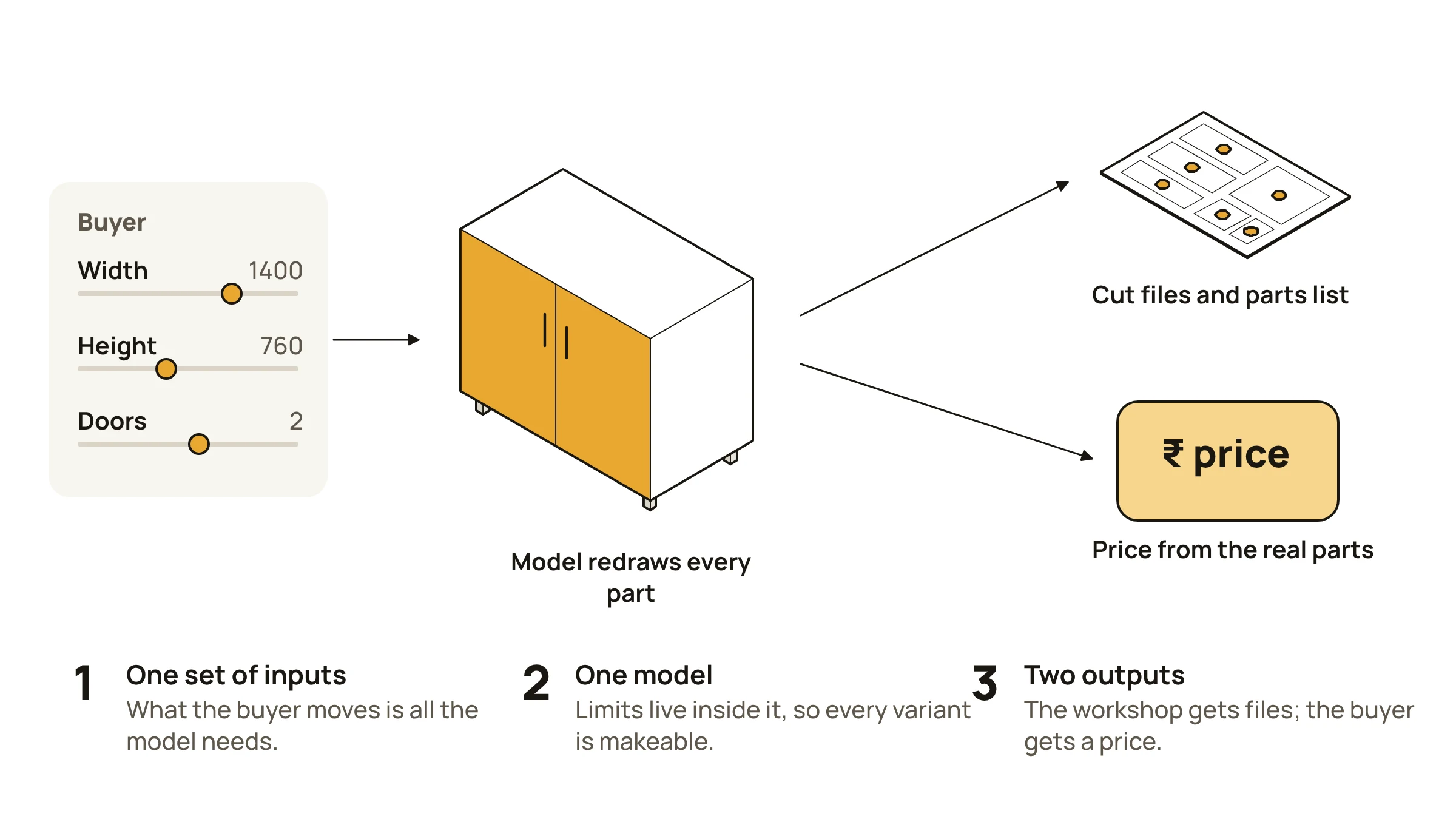
This is how a furniture configurator is built in BeeGraphy. The designer builds the product once as a node graph, picks which inputs the buyer may move and sets their ranges. The same model then drives the configurator the buyer sees and the files the workshop needs. On the BeeGraphy Marketplace, production configurators show the full chain: a wardrobe whose width and height feed a price, a parts list, cutting maps and router programs.
The Ripple Sideboard below is a smaller example you can try right here, and it goes past size into form. Set its width, height and depth, stand it on legs or a plinth, and choose how many doors and shelves it has. The carved ripple across the doors is part of the model too: move the ripple points or the ring spacing and the pattern is redrawn across every door, not stretched.
Try it
Shape a ripple sideboard
Change the size, switch between legs and a plinth, pick the door count, then move Ripple Points and Ring Spacing to redraw the carving. Drag the model to turn it around. It can take a few seconds to load.
Small screen? Open the configurator in BeeGraphy →
None of this removes the designer. It moves their work earlier. Instead of drawing the one right version, they decide which versions are allowed, and the furniture configurator lets the buyer find theirs inside those limits. I wrote about making those calls for a configurable 3D-printed lamp: which parameters to expose, which to lock, and how to keep every variant buildable.
Questions to ask before you build a furniture configurator
If you make or sell furniture and are planning a furniture configurator, these questions decide which level you can honestly offer.
- Which choices do your buyers actually ask for? If most custom orders are about fitting a space, size matters more than a hundred fabrics.
- What range is safe? Write down the smallest and largest value for every dimension, and why. Those limits become the sliders’ ends.
- What must never change? Joint types, board thickness, hardware: fixing these keeps every version makeable.
- How is a custom order priced? By area, by board count, by time on the machine? If you cannot write the rule down, the configurator cannot follow it.
- How does the order reach the workshop? If someone redraws every order by hand, free sizes will cost more than they earn.
Self-check
Where does your furniture configurator sit?
Tick everything a buyer can change on your product today.
Furniture configurator FAQ
What is a furniture configurator?
A furniture configurator is an online tool that lets a buyer change a piece of furniture before ordering it, usually its colour, material, size or layout, and see the result with a price.
What is the difference between a 2D and a 3D furniture configurator?
A 2D configurator swaps pictures or drawings of ready-made variants. A 3D configurator shows a model the buyer can turn and inspect. A parametric 3D configurator goes further: it redraws the model from the buyer’s inputs, so sizes and shapes do not have to be drawn in advance.
Does made-to-measure furniture cost more?
Often, because each order uses a different amount of material and needs its own cutting files. The extra cost shrinks when the model calculates the parts, price and machine files itself instead of a person preparing them for each order.
Can a configurator send orders straight to production?
Yes, if the model behind it produces the files the workshop uses, such as cutting lists, DXF drawings or machine programs. Otherwise someone has to turn each order into drawings by hand.
Sources
- Herman Miller: Eames Lounge Chair and Ottoman
- Vitra: Eames Shell Chairs
- Burrow: Nomad sofa
- Wakefit: Napper sofa
- IKEA: What sizes do PAX wardrobes come in?
- USM: USM Haller
- Apartment Therapy: We tested all the sofas at Interior Define
- Arhaus: Custom upholstery
- Pickawood: Custom cabinet system
- Tylko: Customise storage configurator
- Tylko: What does density mean?
- It’s Nice That: Tylko’s parametric furniture
- form.bar: Curved shelves
- Franke, Schreier and Kaiser, “The ‘I Designed It Myself’ Effect in Mass Customization”, Management Science, 2010
- Matzler, Waiguny and Füller, “Spoiled for choice: consumer confusion in internet-based mass customization”, Innovative Marketing, 2007
- Dellaert and Stremersch, “Consumer Preferences for Mass Customization”, ERIM, 2004